Key Takeaways
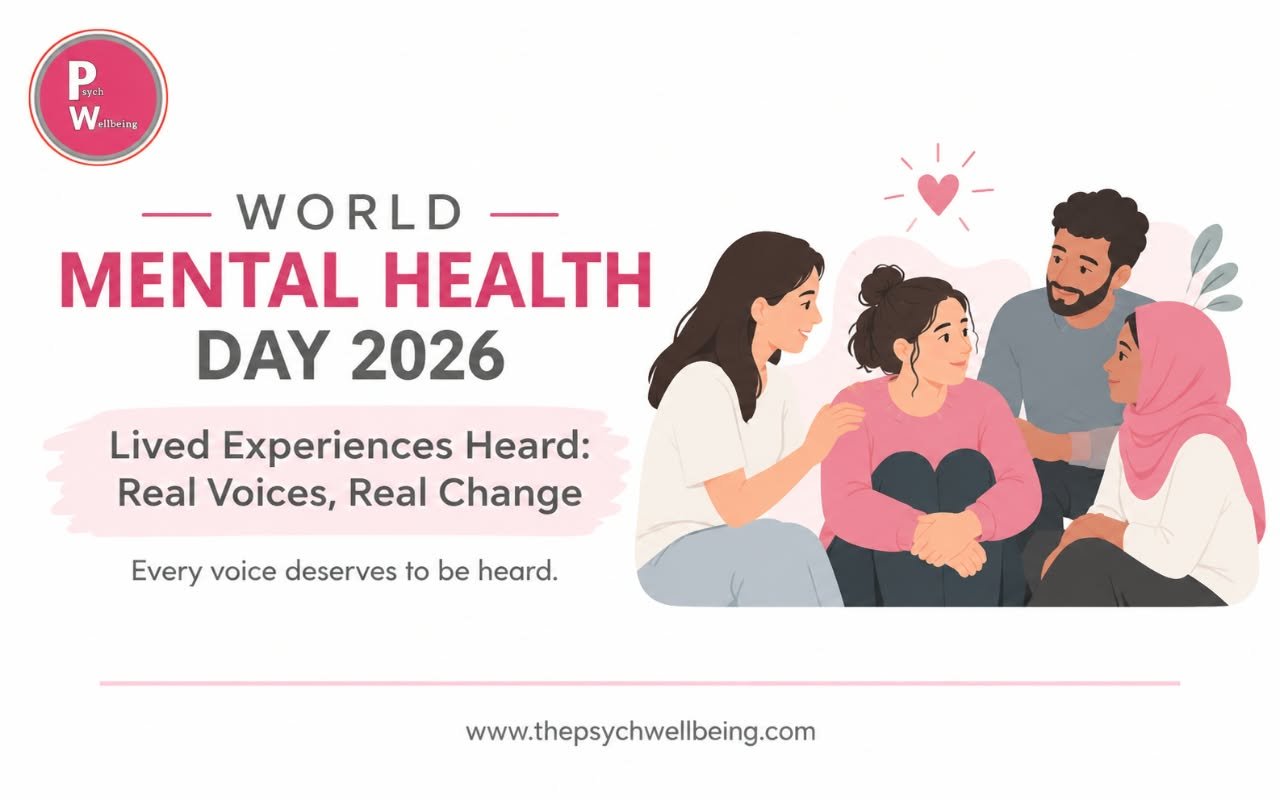
World Mental Health Day 2026 falls on Saturday, 10 October, with the theme "Lived Experiences Heard: Real Voices, Real Change." The campaign calls for people with personal experience of mental health challenges to be included in shaping care and policy — not just asked for a quote. In Pakistan, where stigma and limited access remain significant barriers, this theme matters deeply.
What is World Mental Health Day?
World Mental Health Day is observed every year on 10 October. It was first marked in 1992 on the initiative of the World Federation for Mental Health, which was founded back in 1948, and today it is backed by the World Health Organization. The purpose has stayed steady over the decades: raise awareness, reduce stigma, and push for better access to care.
It is not a celebration in the usual sense. It is more like a collective check in, for individuals, families, workplaces, schools and governments.
What is the World Mental Health Day 2026 theme?
The World Federation for Mental Health announced the 2026 theme in August: Lived Experiences Heard: Real Voices, Real Change. The campaign asks organisations around the world to hold events that reflect this idea, and it also encourages support for the WHO's work on deinstitutionalisation, which means moving mental health care away from large, isolated institutions and towards care that is closer to home and community.
The campaign calls on governments, health systems and communities to treat the knowledge that comes from living through a mental health condition as a real form of expertise. Not a story to be pitied. Not a case study. Expertise.
Why lived experience matters
Think about the last time someone gave you advice about a problem they had never faced. It probably sounded neat and a little hollow.
Now think about the person who has actually walked through anxiety, depression, trauma, addiction or the long road of recovery. They know which words helped and which ones hurt. They know how a waiting room feels when you can barely breathe. They know that "just stay positive" is not a plan.
When services, policies and public campaigns are shaped by people with that experience, a few things change:
- Care becomes more practical, because it reflects what people actually need rather than what looks good on paper.
- Stigma weakens, because ordinary people speaking honestly makes it harder to treat mental illness as something shameful.
- People seek help earlier, because they can see others who did the same and came through.
- Trust grows between communities and the professionals who serve them.
The numbers behind the conversation
According to the World Health Organization's recent global reports, more than one billion people are living with a mental health condition, with anxiety and depression among the most common. Suicide remains a leading cause of death among young people, and WHO estimates that over 700,000 people die by suicide every year. At the same time, countries on average spend only around two percent of their health budgets on mental health.
Those figures should make us uncomfortable. They tell us that need is enormous and investment is small. They also remind us that behind every statistic there is a person whose voice deserves to be heard.
Mental health in Pakistan: where the voices go missing
In Pakistan, the gap between need and care is wide. By commonly cited estimates, the country has only a few hundred psychiatrists for a population of more than 240 million, and trained counsellors and clinical psychologists are concentrated mostly in big cities. If you live in a smaller town or a district like many across Khyber Pakhtunkhwa, getting a proper appointment can mean travelling far, spending money you may not have, and explaining yourself to people who may not understand.
Then there is the quieter barrier: log kya kahenge. What will people say? Many families still see anxiety as weakness, depression as ingratitude and therapy as something only for those who have lost control. Men are told to stay strong and silent. Women are told to adjust and endure. Young people are told they have nothing to be stressed about.
Many people first turn to family, a trusted elder or a faith leader, and that support can be a real comfort. But when symptoms are heavy and long lasting, it should sit beside professional care, not replace it.
This is exactly why the 2026 theme matters here. When a survivor of violence, a student under pressure or a father who lost his job speaks openly about what they went through, someone else in the room realises they are not alone. That is how change begins, one honest conversation at a time.
What does listening actually look like?
Listening is not complicated, but it is a skill. A few ways to practise it this World Mental Health Day:
- At home. Ask how someone is really doing, then wait. Do not rush to fix or compare. Sometimes "that sounds really hard" is the most helpful sentence you can say.
- At work. Managers can make it normal to take a break, say no to an impossible deadline, or admit that a week has been rough. Teams where people feel safe to speak tend to be healthier and more productive too.
- In schools and universities. Students should have somewhere to go that is not tied to marks or discipline. A counsellor who listens can change a young person's whole year.
- Online. Social media can be harsh, but it can also be where someone finally reads a post that says "me too." Share responsibly, avoid jokes about suicide or illness, and be kind in the comments.
- In health care and policy. People with lived experience should be invited into the room when services are designed, not just asked for a quote afterwards.
Five simple ways to take part today
- Check in on one person you have not spoken to in a while, and on yourself too.
- Share your own story if and only if you feel ready. You never owe anyone your pain.
- Listen to someone else's story without interrupting or giving advice.
- Learn the basic signs of common conditions so you can recognise them in people you love.
- Book that appointment you keep postponing, or help someone else make theirs.
When to reach out for professional help
It may be time to speak with a psychologist, counsellor or doctor if you notice that low mood, constant worry, panic, irritability or numbness has lasted for more than a couple of weeks. Other signs include trouble sleeping or sleeping far too much, pulling away from people, loss of interest in things you used to enjoy, difficulty focusing at work or studies, or a feeling that things will never get better.
Online counselling has made support easier to reach, especially for people who cannot travel, who live far from a city, or who feel more comfortable starting from the privacy of their own home. A first session is simply a conversation. You set the pace.
If you or someone near you is thinking about suicide or is in immediate danger, please do not wait. Contact local emergency services, go to the nearest hospital, or reach out to a crisis helpline or a trusted person right now.
Frequently Asked Questions
World Mental Health Day 2026 is on Saturday, 10 October 2026.
The theme is "Lived Experiences Heard: Real Voices, Real Change," announced by the World Federation for Mental Health. It calls for people with personal experience of mental health challenges to be listened to and included in shaping care and policy.
It was started by the World Federation for Mental Health and is supported by the World Health Organization along with partners across the world.
Because mental health affects every part of life, yet many people still stay silent out of fear or shame. The day gives communities a shared moment to talk, learn and push for better support.
Listen without judging, avoid minimising what they feel, gently encourage professional help, and keep checking in. You do not need perfect words. Being present matters more.
A final thought
Mental health is not a topic for one day in October. But days like this give us permission to begin. This year, the invitation is beautifully simple: let people speak, and let what they say change something.
If your own voice has been waiting for a safe place, there is no better time than now. And if someone else's voice reaches you, listen. Real voices, real change starts right there.
This article is for awareness and education and is not a substitute for professional diagnosis or treatment.
Your Voice Matters. Your Mental Health Matters.
If you've been waiting for a safe space to talk, there's no better time than now. Our team of qualified psychologists offers confidential online counselling across Pakistan and internationally.
You don't have to carry this alone. Reach out today.