Key Takeaways
Pashto-speaking psychologists are extremely rare outside Pakistan and Afghanistan, including in countries with established Pakhtun communities like the UK and the Gulf states. Online therapy removes that barrier — you can book a confidential Pashto-language session with a psychologist in Pakistan from anywhere in the world, at a time that fits your schedule.
For Pakhtuns living abroad, finding a psychologist who speaks Pashto is often harder than finding one who speaks Urdu — the diaspora is smaller, the language is less prioritized by foreign training systems, and cultural nuances specific to Pakhtun family life rarely translate into another language. This guide explains where the gap is worst, and how online Pashto-language therapy has started to close it.
Why Overseas Pakhtuns Struggle to Find Pashto-Speaking Psychologists
Mental health workforces abroad are built around whichever languages are most commonly spoken in a given city or region. Pashto — spoken across Khyber Pakhtunkhwa, parts of Balochistan, and Afghanistan — has a smaller global diaspora footprint than Urdu, Punjabi, or Hindi, which means it's rarely a priority language for foreign clinical training programs or public mental health services.
The practical result: a Pakhtun taxi driver in London, a student in Manchester, or a labourer in Dubai can often find a general therapist, but almost never one who speaks Pashto and understands Pakhtunwali-influenced family structure, the weight placed on honour and reputation, or the specific stress of maintaining ties to a tribal or extended family system while living thousands of miles away.
Countries Where Pashto-Speaking Psychologists Are Rare
Based on client inquiries we receive at The Psychological Wellbeing, the shortage of Pashto-speaking psychologists is consistently reported across these regions with established Pakhtun communities:
- United Kingdom — Cities like Bradford, Birmingham, and parts of London have long-settled Pakhtun communities, yet Pashto-fluent mental health professionals within the NHS or private practice remain almost nonexistent.
- United States — Pakhtun families settled in cities like New York, Virginia, and California often find Urdu- or Hindi-speaking South Asian therapists before finding anyone who speaks Pashto specifically.
- Gulf countries (Saudi Arabia, UAE, Qatar) — Home to a very large number of Pakhtun labourers and expatriate workers, but local mental health infrastructure for expatriates rarely includes Pashto-speaking staff.
- Afghanistan-adjacent diaspora communities — Pashto speakers from both Pakistan and Afghanistan living in Europe often share this same gap, since Pashto-speaking clinicians are scarce across almost every Western mental health system.
Across all of these regions, the underlying issue is the same: a real, present Pakhtun population, and a mental health workforce with almost no capacity to serve them in their own language.
Why Language and Culture Matter in Therapy
Therapy depends on a client being able to describe exactly what they feel, and for many Pakhtuns, that vocabulary lives in Pashto — not in English or even Urdu. Concepts tied to ghairat (honour), sharam (shame), or the responsibilities of being the eldest son abroad often don't have a clean equivalent in another language, and clients can spend more energy translating than actually processing what they're going through.
A psychologist familiar with Pakhtun culture also understands the context without needing it explained from scratch — the weight of Pakhtunwali, the importance of family reputation, the pressure of sending money home, or the isolation of being far from a tightly-knit community. That shared understanding often gets to the real issue faster than starting from zero with a therapist unfamiliar with any of it.
Stigma and Seeking Help in Pakhtun Communities
Mental health stigma exists across Pakistani culture broadly, but it can carry extra weight in Pakhtun communities, where family reputation and the concept of nang (honour) are taken seriously. Admitting to struggling emotionally can feel, to some, like admitting weakness in a culture that prizes resilience and self-reliance — especially for men, who may feel they're expected to "handle it" alone.
This is a cultural pattern, not a personal failing, and it's slowly changing. Confidential, culturally aware therapy — where a client doesn't have to worry about word getting back to their community — is one of the main reasons online sessions have become a preferred option for many overseas Pakhtuns.
How Online Pashto-Language Therapy Works
Online therapy removes the geographic problem entirely. Instead of searching for a Pashto-speaking psychologist locally — who, in most cities abroad, simply doesn't exist — you can book a confidential session with a psychologist in Pakistan over secure video call, at a time that fits your schedule, whether you're in London, New York, Dubai, or Doha.
Sessions follow the same format as in-person therapy: the same confidentiality standards, the same evidence-based approaches, and the same 50-minute to one-hour structure — just conducted in the language you're most comfortable expressing yourself in.
Meet Our Pashto-Speaking Psychologists at the Psychological wellbeing centre
At The Psychological Wellbeing, we're one of the leading online counselling and therapy centres offering Urdu-language sessions to clients across Pakistan and the overseas Pakistani community. Our Urdu-speaking psychologists include:
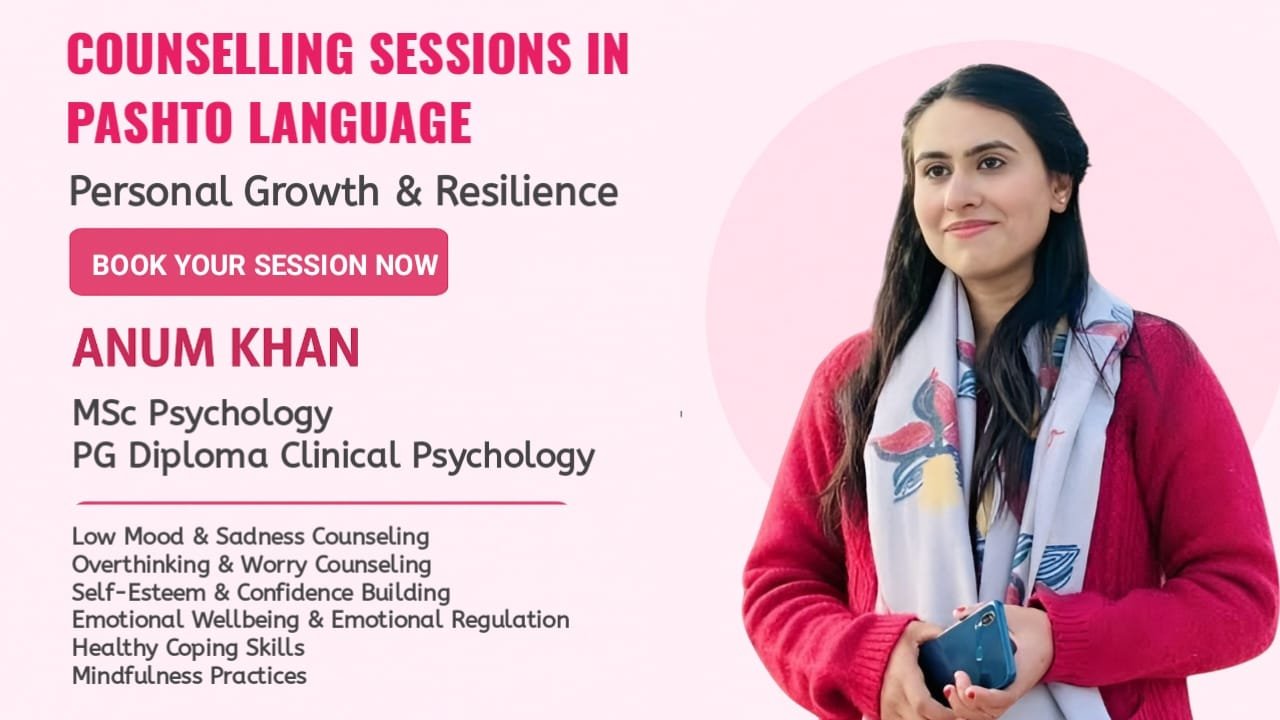
- Anum Khan – Anxiety & Depression, Relationship issues, CBT approaches and more
- Mehak Fatima – Child & Adolescent Psychology, Behavioral Issues, Family Counseling
- Aqsa Ijaz – Relationship Counseling, Stress Management, Mindfulness-Based Therapy
Whether you need support with anxiety and depression, your child's behavioral concerns, marital or relationship stress, or general overwhelm from adjusting to life abroad, there's an Urdu-speaking psychologist on our team suited to your concern.
What to Expect in Your First Session
Your first Pashto-language session is simply a conversation. Your psychologist will ask about your background, what's brought you to therapy, and what you're hoping to work through — there's no expectation that you'll have everything neatly explained beforehand. Many clients find it easier to open up once they realise they can describe what they're feeling in the language they actually think in, without translating in their head first.
This article is for general informational purposes and does not replace professional diagnosis or treatment. If you are struggling with your mental health while living abroad, please consult a licensed psychologist or counsellor.
Frequently Asked Questions
Pashto is spoken by a comparatively small diaspora population relative to Urdu, Punjabi, or Hindi, so it is rarely prioritized by mental health training programs in Western countries. This leaves Pakhtun communities abroad with almost no access to therapists who share their language and cultural background.
Pakhtun communities in the United Kingdom (particularly Bradford, Birmingham, and London), the United States, and Gulf countries such as Saudi Arabia, UAE, and Qatar frequently report being unable to find a licensed psychologist who speaks Pashto, despite sizeable Pakhtun populations in each region.
Yes. Online therapy removes the geographic barrier entirely — you can book a confidential Pashto-language session with a psychologist in Pakistan over video call from the UK, US, Gulf, or anywhere else, at a time that fits your time zone.
Stigma around mental health is common across Pakistani culture generally, but it can be especially pronounced in Pakhtun communities, where concepts like nang (honour) and family reputation add extra weight to seeking outside help. This is a cultural pattern, not a personal failing, and it's changing as more people access confidential, culturally aware therapy.
Yes. The Psychological Wellbeing can arrange sessions in Pashto on request. Contact the team directly via WhatsApp or email to be matched with a psychologist for a Pashto-language session.
Looking for a psychologist who speaks Pashto?
Message us to arrange a confidential Pashto-language session, online from anywhere in the world.